
MY SWING

Who I Am
In 1995, Moe Norman was conducting a golf clinic in Chicago. Intrigued, I drove down to watch him in action. After observing him for a while, I walked over and asked, “Moe, how do you do that? What are you doing?” His response was both unexpected and enlightening. He turned around, picked up his club, and without much elaboration, yelled, “Watch, watch! It’s just hitting a ball with a stick.” This seemingly simple statement contained layers of meaning that I only began to understand during my first PGA Tour tournament—the Hawaiian Open in 1968. During that tournament, I shot 66 and 67 in the early rounds and found myself leading the competition. In the final round, I played alongside Lee Trevino, who had just won the U.S. Open. Trevino put his arm around me and said, “Just watch, and I’ll show you how it’s done.” That moment, coupled with Moe’s advice, marked the beginning of a deeper understanding of golf. Remember my motto: see it, know it, believe it, do it, and own it.
Is There a Perfect Swing?
Throughout my years of playing and teaching golf, I have never found a perfect swing. The concept is elusive because swings are highly individual. If anyone came close, it was Moe Norman, one of the world’s top ball strikers alongside legends like Lee Trevino and Ben Hogan. The secret lies in understanding the common denominators of skilled players—the “slot” being one of the most crucial elements.
What I teach… I call it a “progressive motion”, which combines the knowledge of what I have learned from Moe Norman, Lee Trevino and Ben Hogan.
Address
-
Double Tilt: The upper body assumes two distinct tilts. First, the spine tilts toward the ball (red line), creating a stable shoulder position. Second, the shoulders tilt away from the target (yellow line), ensuring balance and alignment.
-
Body Weight: Counterbalance is key. This involves opposing forces to maintain equilibrium. My driver stance is wider, while it’s more natural for irons.
Takeaway and the Slot
Takeaway:
-
- Left shoulder, elbow, forearm, and wrist move as one.
- Left shoulder rotates; right shoulder and forearm supinate.
- This creates the “first corner”—shaft parallel to the ground and aimed at the target.
- Right elbow folds, establishing the swing plane.
The Slot:
-
- Begins here, described as a “window” between the elbows.
- Belly button and tailbone alignment is key.


Takeaway and the Slot
IN THE TAKEAWAY: from the ball. The left shoulder to the elbow to the
forearm to the wrist should be as one. The left shoulder will rotate while the
right shoulder and forearm will supinate, achieving a position known as
the first corner. At the corner, the shaft should be parallel to the ground
and the shaft aimed at the target. The momentum of the backswing
creates a crucial fold in the right elbow, establishing the plane for your
golf swing.
This is the beginning of the slot it will be described as a window. This
window, positioned between the elbows, provides a view towards the
target line. This terminology refers to the concept known as the slot.
Notice the relation between the belly button and the tail bone.
First, look at the yellow line from PG 3 to PG 4 (A) and PG 4 (B).
• Notice the hip turn: the relationship of the belly button to the tailbone.
• The body rotates centrally, with the navel moving backward and the
tailbone rotating.
• This is known as addressing the ball at impact.
• Red lies are swing positions.
• The hands and elbows are on a single plane.
• The limbs exhibit coordination and balance evenly.

Change of Direction From Back to Front = (Moe’s) Vertical Drop, Gravity
Drop.
• Change of direction by body weight drop to right knee, moves to the left
foot. Rotate the hips and tailbone while maintaining counterbalance with
the navel.
• Look at the swing plane. This is as good as it gets. The left hand is flat, the
club face and shaft are square to the swing plane.
• The club will fall into the designated slot. I like what Sam Snead said, “sit
down on the toilet and don’t miss the slot,”
• I really like the butt of the club is right on top of the right knee and the
shoulders, hips, and feet are square to the target line.
• This is the most important part of the swing. I will quate Moe “how to hit
the ball with a stick. He said, BUCKLE, SIT. SLIDE AND BUMP”, Moe grew up
in Canada and the first time he hit it with a hocky stick.so I will interpret,
his riddle. Buckle = belly button is turning and lifting in the backing. Sit =
return the turn and squat down dropping the club into the window to see.
Slide = like a hocky slap shot sliding and turning into the left leg. Bump =
the impact in a straight-line motion.
First, look at the yellow line from PG 3 to PG 4 (A) and PG 4 (B).
• Notice the hip turn: the relationship of the belly button to the tailbone.
• The body rotates centrally, with the navel moving backward and the
tailbone rotating.
• This is known as addressing the ball at impact.
• Red lies are swing positions.
• The hands and elbows are on a single plane.
• The limbs exhibit coordination and balance evenly.

This is the Slot
See it, know it, believe it, do it, practice and own it.
• Can you see the target through the window between the elbows? The
momentum will lift the weight of the heel off the ground to finish. Do not lift
the heal out of sequence. Remember the timing chain. Rhythm = tempo.
balance and timing. Use the right part at the place.
• It is all about impact. Straight line motion = the shoulder (axis) is a straight
line to the wrist.
• Keep the shoulder angles and spine aligned.
• Keep your eyes aligned with your shoulders while on the plane.
- See the window at impact.
- Double Tilt.
- Straight line motion at impact.
- The straight-line motion system operates along a single axis and within a single plane, similar to the technique used by Moe Norman.
- Players such as Hogan and Trevino use a double-axis and a double-plane swing. And there are hybrids of each other.
- For myself, I am in Moe’s camp. Although Moe is five feet eight, and I am
or was six feet four, I am close but unable to replicate Moe exactly. I
would like to acknowledge Todd Graves, who worked with me. He is
highly competent and professional. If you are interested in Moe’s swing,
consider buying his book or attending one of his schools.
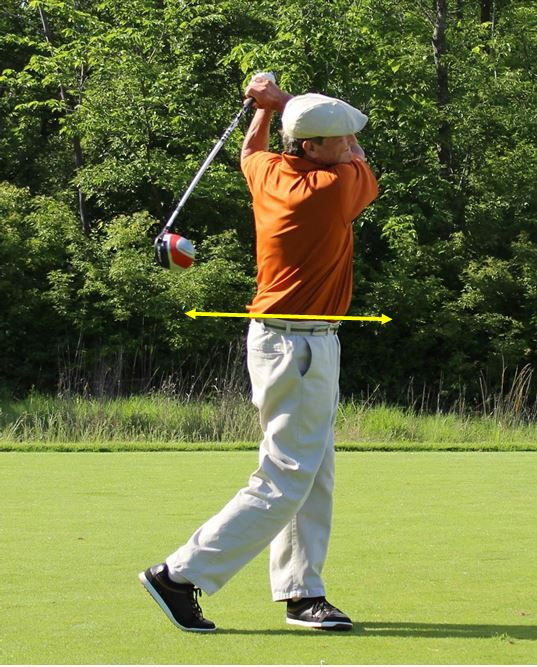
This is the last photo of my swing. I was seventy-two years old and
three years post heart transplant.
This is important to remember this photo about the belly button and
the tailbone. In the beginning the tailbone moves forward and the
club moves backward. If you repeat this a few times forward, back,
forward, back. You created a waggle. Now waggle forward and
step down on the left foot, then waggle backward and step on the
right foot. Repeat this over and over. Now get the beat, one two,
ca, ca. ca. One two, one two three. That rhythm. Dance with your
feet and waggle with your tailbone. That is a golf swing. Moe, Ben,
and Lee were all committed to it. They never made a swing without
it.
Is There a Perfect Swing?
Throughout my years of playing and teaching golf, I have never found a perfect swing. The concept is elusive because swings are highly individual. If anyone came close, it was Moe Norman, one of the world’s top ball strikers alongside legends like Lee Trevino and Ben Hogan. The secret lies in understanding the common denominators of skilled players—the
“slot” being one of the most crucial elements. Let’s explore what makes a swing effective.
Address
Double Tilt: The upper body assumes two distinct tilts. First, the spine tilts toward the ball (red line), creating a stable shoulder position. Second, the shoulders tilt away from the target (yellow line), ensuring balance and alignment.
Body Weight: Counterbalance is key. This involves opposing forces to maintain equilibrium. My driver stance is wider, while it’s more natural for irons.
Takeaway:
The initial movement involves the left shoulder, elbow, forearm, and wrist working as a single unit. The left shoulder rotates while the right shoulder and forearm supinate, leading to a position called the “first corner.” At this corner, the shaft is parallel to the ground and aims at the target.
This motion creates the essential fold in the right elbow, forming the plane for the golf swing. The “window,” positioned between the elbows, provides a view toward the target line and introduces the concept of “the slot.”
Change of Direction
The transition from backswing to downswing is driven by gravity. Body weight shifts from the right knee to the left foot while the hips rotate, maintaining counterbalance with the navel.
The club naturally falls into the slot, aligning with the swing plane. Sam Snead
likened this to “sitting on the toilet and not missing the slot.” At this stage, the club face and shaft remain square to the plane, ensuring precision.
Impact:
Moe Norman described impact with the terms “buckle, sit, slide, and bump.” These words encapsulate key movements: “Buckle” reflects the turning and lifting of the belly button; “sit” represents the squat-like drop of the club into the window; “slide” mimics a hockey slap shot into the left leg; “bump” captures the straight-line motion at impact.
Maintain alignment of the shoulders, spine, and eyes throughout the swing. Rhythm, tempo, and timing are essential to achieving a fluid motion.
Finishing the Swing
The momentum of the swing naturally lifts the heel off the ground in sequence with the finish. The straight-line motion system operates along a single axis and within a single plane—similar to Moe Norman’s technique.
Although players like Hogan and Trevino use double-axis swings with hybrid planes, Moe’s single-plane system remains unmatched for simplicity and effectiveness.
Acknowledgments:
I owe much of my technical understanding to Todd Graves, whose expertise and professionalism are unparalleled. If you’re interested in Moe Norman’s swing, consider reading his book or attending one of his schools. This swing philosophy is timeless, as demonstrated by my own photo taken at age seventy-two, three years after a heart transplant.
The Waggle and Rhythm:
The waggle begins with the tailbone moving forward and the club moving backward. Repeating this motion forward and back creates a beat—one, two, ca, ca, ca. This rhythm connects the body and club in harmony. Players like Moe, Ben Hogan, and Lee Trevino never made a swing without it.
Contact and Frequently Asked Questions
Get in touch with Ken or read our FAQ below.
What Led You to God?
Nemo enim ipsam voluptatem quia voluptas sit aspernatur aut odit aut fugit sed quia consequuntur magni dolores eos qui ratione.
How Did Your Golf Game Level Up?
Nemo enim ipsam voluptatem quia voluptas sit aspernatur aut odit aut fugit sed quia consequuntur magni dolores eos qui ratione.
Dolore magnam aliquam quaerat?
Nemo enim ipsam voluptatem quia voluptas sit aspernatur aut odit aut fugit sed quia consequuntur magni dolores eos qui ratione.
Illum qui dolorem eum fugiat?
Nemo enim ipsam voluptatem quia voluptas sit aspernatur aut odit aut fugit sed quia consequuntur magni dolores eos qui ratione.
Contact Ken Here
Newsletter
Subscribe to our newsletter
Stay up to date with Ken Ellsworth & the world of Golf.